
When a Leaning Tree Is a Problem and When It Isn’t
The way most people approach a leaning tree is wrong. A tree that leans gets treated as an emergency. Half the time it is not. Plenty of trees grow at an angle their entire lives — leaning toward sunlight, shaped by prevailing wind, or simply rooted on a slope. Those trees formed their wood grain to handle the load. They are fine.
The trees that are not fine are the ones that started vertical and recently moved. That is the distinction. A tree that has always leaned is probably stable. A tree that is newly leaning has a root problem. Here’s how to tell the difference.
The three things to check
Most leaning-tree assessments come down to three observations that do not require any equipment.
1. Is the lean new?
This is the single most important question. A tree that has leaned 15 degrees for thirty years formed reaction wood along the entire trunk to handle that geometry. The wood on the compression side is denser. The root plate on the uphill side is more developed. The tree adapted.
A tree that leaned 5 degrees this year did not form reaction wood. The roots on one side failed. The lean is a symptom, not a growth pattern. The USDA Forest Service hazardous defect guide identifies “recent change in lean” as one of the highest-priority structural risk factors — above cracks, above cavities, above deadwood.
If there are photos from last year or the year before, compare them. If the lean is new, the decision timeline has shortened significantly.
2. Is the soil heaving on the uphill side?
When a root plate fails and a tree begins to tip, the soil on the side opposite the lean lifts. Cracks open in the ground. Turf separates. Sometimes the entire root mass visibly pushes upward. This is called soil heaving, and it is the ground-level confirmation that the root plate has partially released.
Soil heaving on the uphill side of a leaning tree is an urgent signal. The tree has already begun the failure process. The only question is how fast it finishes.
3. What is in the fall zone?
A leaning tree in an open field with nothing in its fall path is a monitoring situation. A leaning tree aimed at a house, a driveway, a power line, or a play area is a different category entirely. The risk is not the lean itself — the risk is what the lean is pointed at.
ISA’s hazard recognition materials define “target” as the critical variable. A defective tree with no target is a low-risk tree. The same defect with a high-value target — a structure, a road, a gathering area — is a high-risk tree.
Why trees develop new lean
The most common causes of new lean in Central PA:
Root decay. Fungal infection in the structural roots — Armillaria, Ganoderma, Phytophthora — gradually removes the root mass on one side. The lean develops slowly at first, then accelerates when the remaining roots can no longer hold the load.
Saturated soil. Central PA’s clay-heavy soils hold water. After a prolonged wet period, the soil matrix softens and the root plate’s grip loosens. Trees that were stable in dry conditions can shift in saturated ground — and then the lean becomes permanent even after the soil dries.
Root severance. A utility trench, a driveway expansion, or a grade change that cuts structural roots on one side of the tree removes the anchoring system. The lean may appear months or years later when a wind load tests the weakened side.
Asymmetric crown weight. A tree that lost a major limb on one side — from storm damage, from pruning, from a neighbor trimming their side — is now weight-unbalanced. The remaining crown pulls the tree toward the heavy side. In practice, this cause is less common than root failure, but it shows up after major storm-pruning events.
The removal question
Here’s what to do when a newly leaning tree is aimed at something valuable:
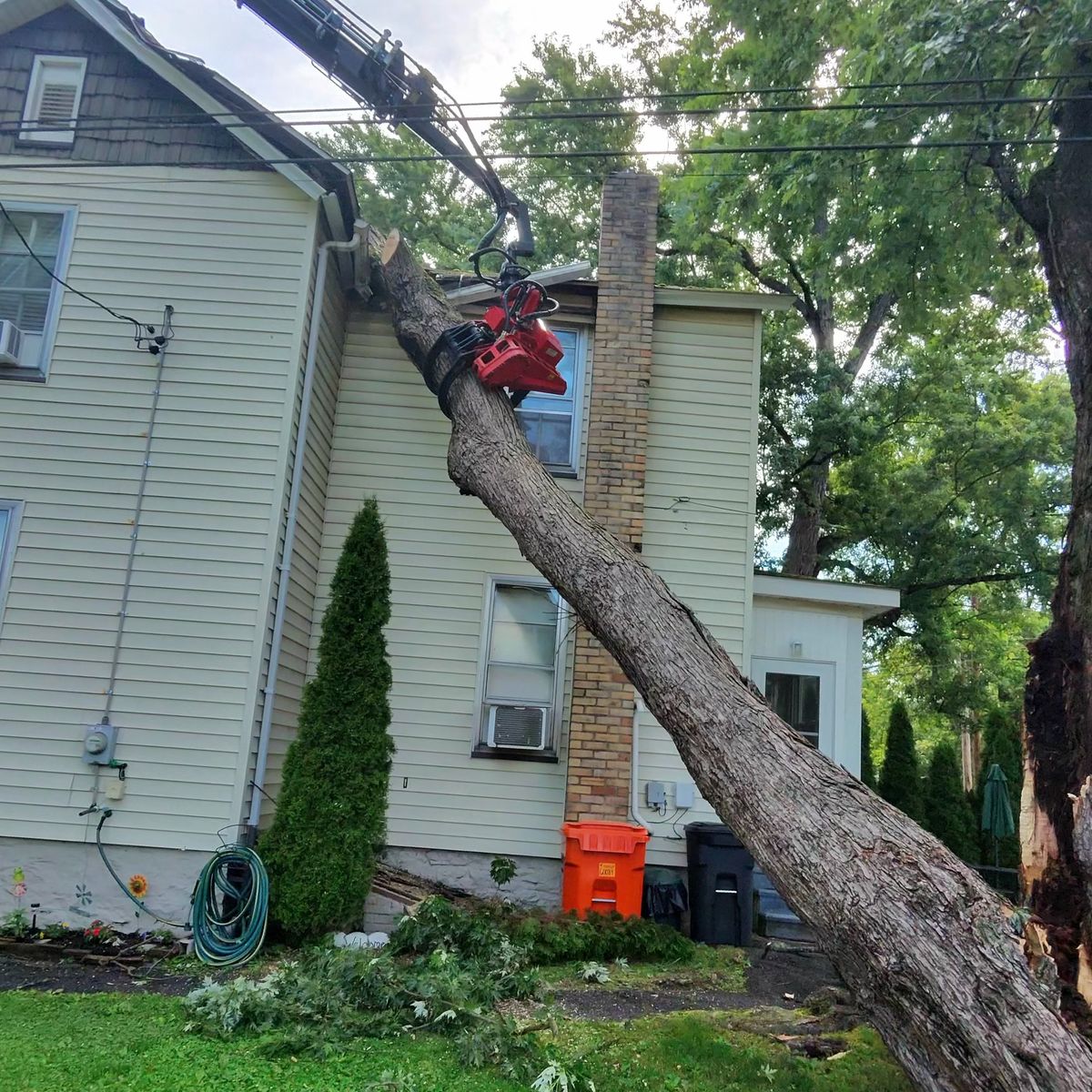
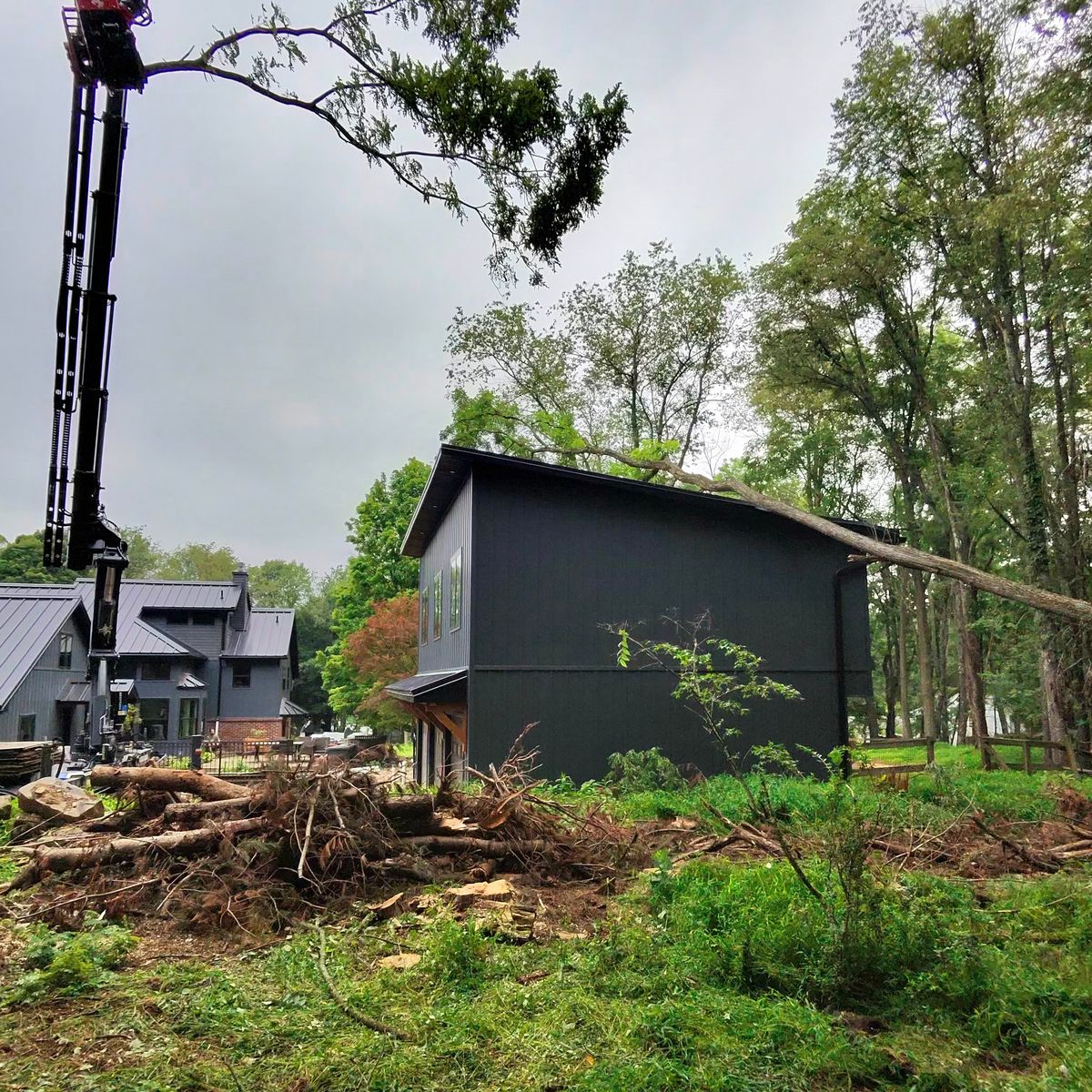
Do not wait for the next storm to make the decision. A planned removal with the right equipment — often a crane when the lean is toward a structure — is controlled, predictable, and significantly cheaper than an emergency call after the tree has fallen partway and is hung up against the house.
The honest answer is that most newly leaning trees do eventually fail. The timeline ranges from days (saturated soil + wind event) to years (slow root decay). The question is not whether to act. It is whether to act on a planned schedule or an emergency schedule.
What not to do
Do not cable a newly leaning tree without a structural assessment. Cables redistribute load between branches — they do not prevent root-plate failure. A cable on a tree with a failing root plate gives a false sense of security.
Do not try to straighten a mature leaning tree. Staking and guy-wiring work on newly planted trees. On a mature tree with a compromised root system, pulling the trunk vertical creates torque the weakened roots cannot handle. The tree either snaps the cables or fails in a different direction.
Do not wait for a second lean event to confirm the first one. If the lean is new and the tree is aimed at a target, one event is enough data.
For a leaning-tree assessment in Centre County or the surrounding region, call (814) 553-0303. Arbor Pro’s Tree Service operates under PA Contractor License PA079160.