
When Your HOA Hasn’t Budgeted for Tree Work: The Year-Five Math
Every HOA eventually figures this out the hard way. The first four years after the community is built, nobody thinks about the trees. They are small. They are not blocking anything. They are not on anyone’s annual budget sheet. Then year five arrives, and three things happen at once: the maples along the entry road are now shading the pavement through every winter, a limb drops across a private drive during a February ice storm, and the board discovers the reserve study never had a line-item for vegetation. Pay now or pay later. This post is about what “later” actually costs.
The budget gap most HOAs in Central PA share
Boards in Centre, Blair, and Huntingdon County tend to plan for roofs, paint, and paving. Those line-items show up in every reserve study. Trees are treated as a landscape amenity and funded out of the operating budget — a line for “mowing and landscaping” that was sized when the community was new. At year five, that line is still sized for mowing. The trees have grown 20 to 30 feet. The gap between what the landscape budget covers and what the tree canopy now requires is the gap that funds every emergency call in year six.
Pennsylvania’s Governor’s Center for Local Government Services publishes guidance for municipalities on long-horizon maintenance planning, and the logic transfers directly to homeowner associations operating private road networks. Defer the recurring expense, and the reactive expense replaces it at a multiple. For tree work, that multiple is somewhere between 3x and 7x depending on the access problem.
Why reactive tree work costs so much more than recurring tree work
Three cost drivers separate a scheduled trim from a storm-night removal.
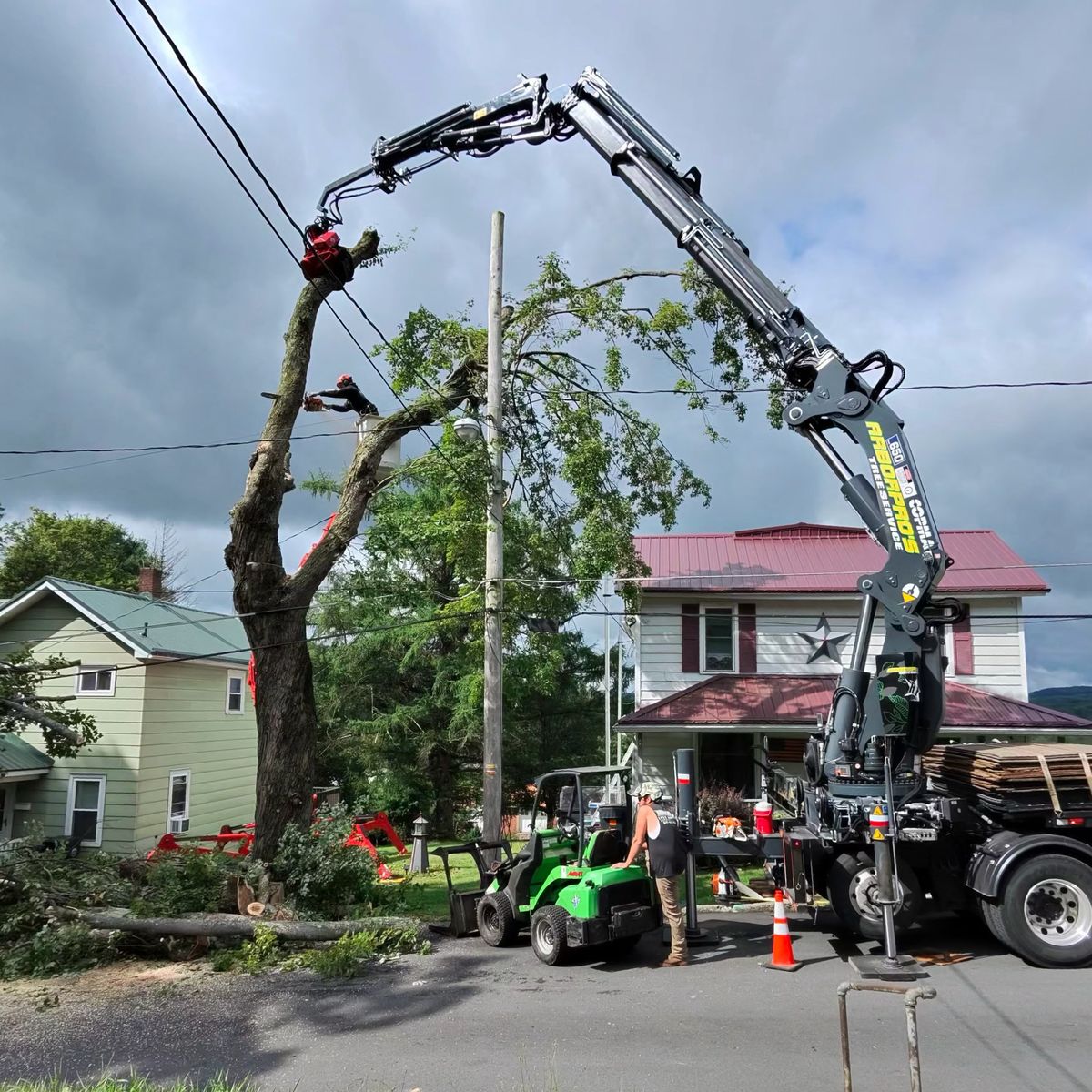
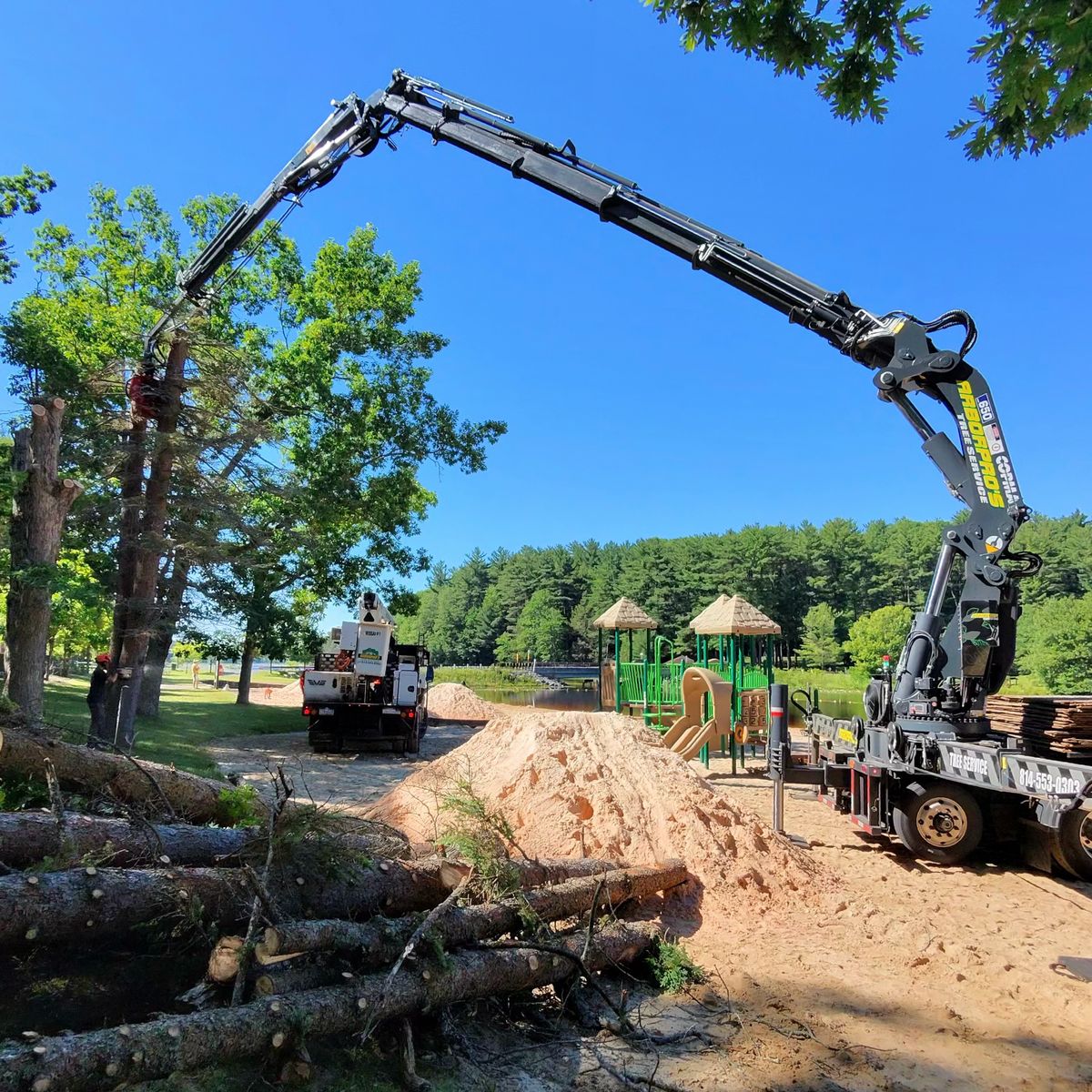
First, access. A planned crew pulls up to a corridor in daylight, sets cones, and works a controlled drop zone. A storm-night crew is navigating a limb across a closed road, sometimes with a live utility line tangled in it. That job takes a bucket truck, a crane, or a spider lift depending on what the tree is leaning against. Equipment-heavy jobs run hundreds per hour. A scheduled trim on the same tree, two years earlier, would have been a fraction of that.
Second, disposal. Planned work is chipped on-site, loaded, and hauled to a single yard-waste destination. Emergency work often ends up staged at the roadside for days because the property has no staging area, and hauling becomes a second mobilization. That mobilization is a second bill.
Third, liability exposure. If a limb has been documented as a known hazard — a prior inspection noted it, an email thread mentioned it, a resident complained at the March meeting — and it then falls and damages a car or a person, the insurance conversation gets complicated fast. Documented maintenance is a defensible position. Documented inaction is not.
What road daylighting changes
Road daylighting — clearing the canopy back from the edge of pavement so sunlight and air reach the road surface — is the single maintenance practice that moves an HOA from reactive to recurring. PennDOT’s roadside vegetation guidance for state routes calls for a clear corridor along the shoulder for drainage, snow storage, and sight distance. On a private HOA road, the same physics apply. A daylit road dries faster after rain. It sheds ice faster after a storm. It holds its asphalt through freeze-thaw cycles that would otherwise open cracks every winter.
FHWA’s roadway safety materials document the crash-risk consequences of blocked sight distance at intersections and curves. On a private road with residents, children, and delivery trucks, that math runs the same direction. Trimming the corridor back to daylight is not a cosmetic decision. It is an insurance decision, a pavement-preservation decision, and a sight-distance decision. The road daylighting page has the equipment and method details.
The five-year cycle that actually works
Penn State Extension’s community forestry materials describe tree inspection and maintenance on a multi-year cycle rather than as an annual line-item. That is the right frame for an HOA. A working version looks like this:
- Year one: walk the entire road corridor with a qualified crew. Document every tree within striking distance of pavement, structures, or utility lines. Flag hazards for removal. Flag priority trims for year two.
- Years two and three: execute the priority trims. Remove the hazards. Establish a baseline corridor.
- Years four and five: walk again, same crew, same documentation. Re-trim anything that has grown back into the corridor. Remove any trees that have declined since the first walk.
- Repeat.
Budgeted across five years, recurring maintenance on a 40-unit HOA with typical road frontage tends to cost less than one multi-tree emergency event. The board that runs this cycle is not paying more. It is paying earlier, in smaller increments, on a schedule that makes the insurance carrier happy.
What to do this quarter
If the HOA has not had a tree assessment on the road corridor in the last five years:
- Ask the landscape committee to request a corridor walk from a PA-licensed tree service. In Pennsylvania, that means PA Contractor License verification. Arbor Pro’s Tree Service operates under PA079160.
- Ask the reserve study preparer at the next update whether vegetation has a line-item. If it does not, add one.
- Pull the last five years of emergency tree invoices. That number is the floor for the recurring budget. The real number is usually higher.
- Check whether any of the HOA’s private roads run under utility lines. Coordination with the utility line clearing crew avoids double-billing and double-scheduling.
The question is not what the work costs. It is what the work costs to defer. Call (814) 553-0303 for a corridor walk across any HOA or private road community in Centre County and the surrounding region.