Road Daylighting & Roadway Canopy Clearance
Raising the canopy over your road, driveway, or right-of-way. Longer asphalt life, faster snow melt, better sight lines, lower liability.
Daylighting is the professional term for cutting back the tree canopy above a roadway so sunlight reaches the pavement. PennDOT cites tree trimming as a direct factor in extending the service life of Pennsylvania roads — sun hits the asphalt, snow and ice melt faster, freeze-thaw cycles are reduced, and potholes form more slowly. It also opens sight lines to traffic signs, intersections, and oncoming traffic, and removes the dead or leaning branches most likely to come down in a storm.
If your township, HOA, private road association, or utility right-of-way hasn’t had the canopy cut back in five-plus years, it’s overdue. Arbor Pro’s does daylighting work across Central Pennsylvania with the equipment and EHAP certification most crews don’t have.
What road daylighting actually does
- Extends pavement life. PennDOT has documented that daylit roads see less freeze-thaw damage and fewer potholes. Sunlight on the surface is a low-cost form of pavement preservation.
- Speeds snow and ice melt. Shaded roads stay icy long after open roads dry out. Daylit corridors need less plowing and less salt, and they thaw on their own during sunny winter days.
- Opens sight distance. FHWA safety guidance calls for stop and yield signs to be readable from 250 feet on 30 mph roads and 600 feet on 60 mph roads. Overhanging limbs routinely block these sight lines without anyone realizing it.
- Reveals signs and signals. Speed limit signs, warning signs, traffic signals, streetlights — all routinely blocked by limbs homeowners don’t notice until someone misses a stop.
- Removes storm risk. The dead, hollow, and leaning limbs overhanging a road are the ones most likely to come down in a storm and close the road, tear a power line, or land on a vehicle.
- Reduces liability. For HOAs, private road associations, and commercial property managers, overhanging dead limbs that you “should have known about” are a documented liability exposure.
What we clear
- Vertical clearance — raising the canopy to a consistent height above the road surface (commonly 14 ft for vehicle corridors, 8 ft above walkways; specific height set by your jurisdiction or your preference)
- Intersection sight triangles — clearing the limbs that block sight distance approaching stop signs, yield signs, and driveways
- Sign and signal visibility — removing branches in front of traffic control devices
- Dead, dying, and hazard limbs — the storm-risk priority on any road-corridor pass
- Utility-adjacent limbs — coordinated with power-line clearance when the road and the line share a corridor
Who hires us for daylighting
- Townships and municipalities — budgeted road-corridor maintenance, typically on a rolling 3-to-5-year cycle
- HOAs and private road associations — shared-ownership roads where no one department is funding vegetation work by default
- Rural homeowners with long driveways — wooded driveway corridors that haven’t been touched since the house was built
- Commercial property managers — parking lot access roads, campus roadways, industrial corridors
- Utility contractors — coordinated daylighting plus utility line clearance in shared road/line corridors
Why the equipment matters
Daylighting is not one-tree-at-a-time work. A half-mile of rural road can have a hundred or more limbs overhanging the pavement. Doing it efficiently and safely takes the right fleet:
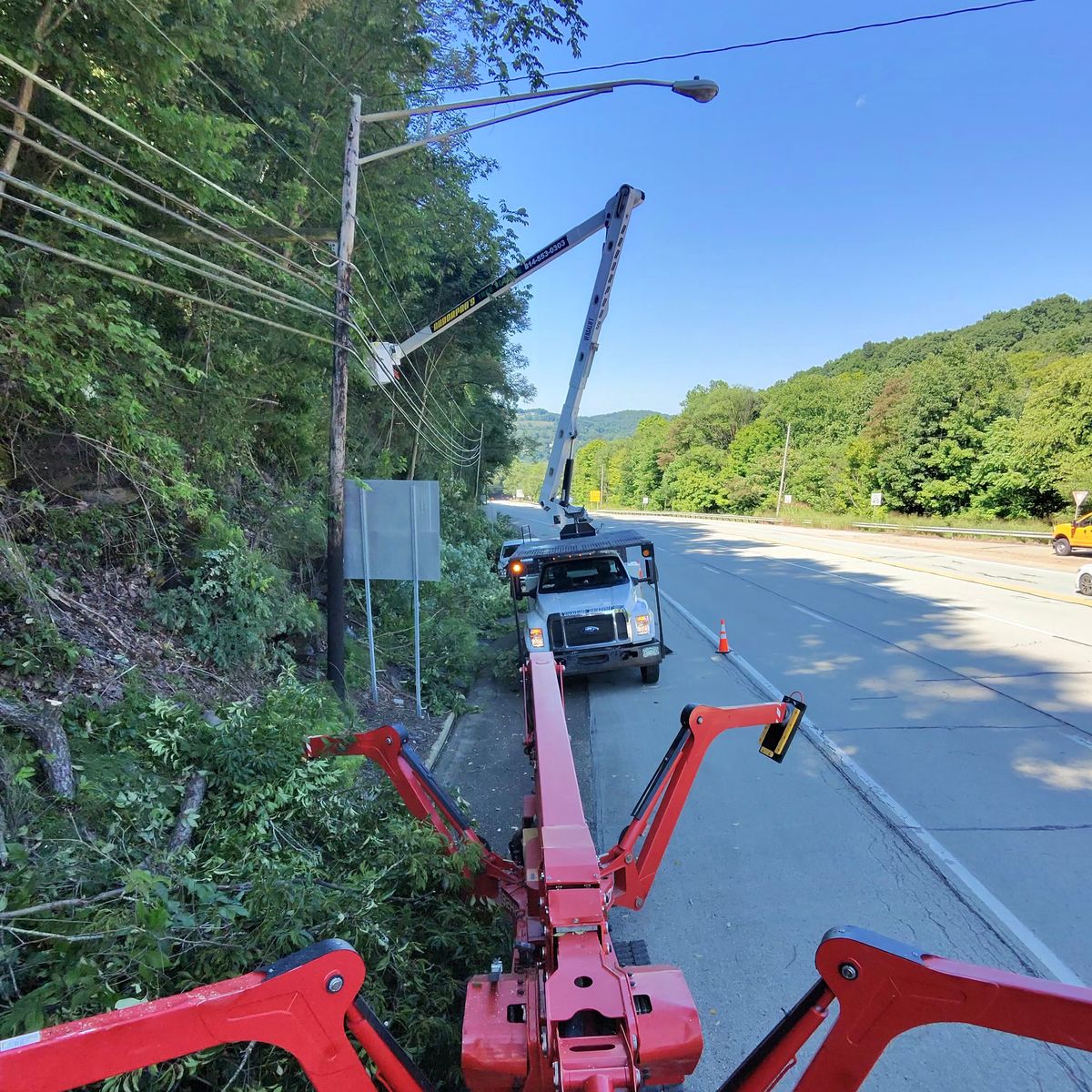
- Bucket trucks and spider lifts for the bulk of the canopy work
- Low-ground-pressure tracked lifts for the shoulder and embankment work where wheeled equipment can’t set up
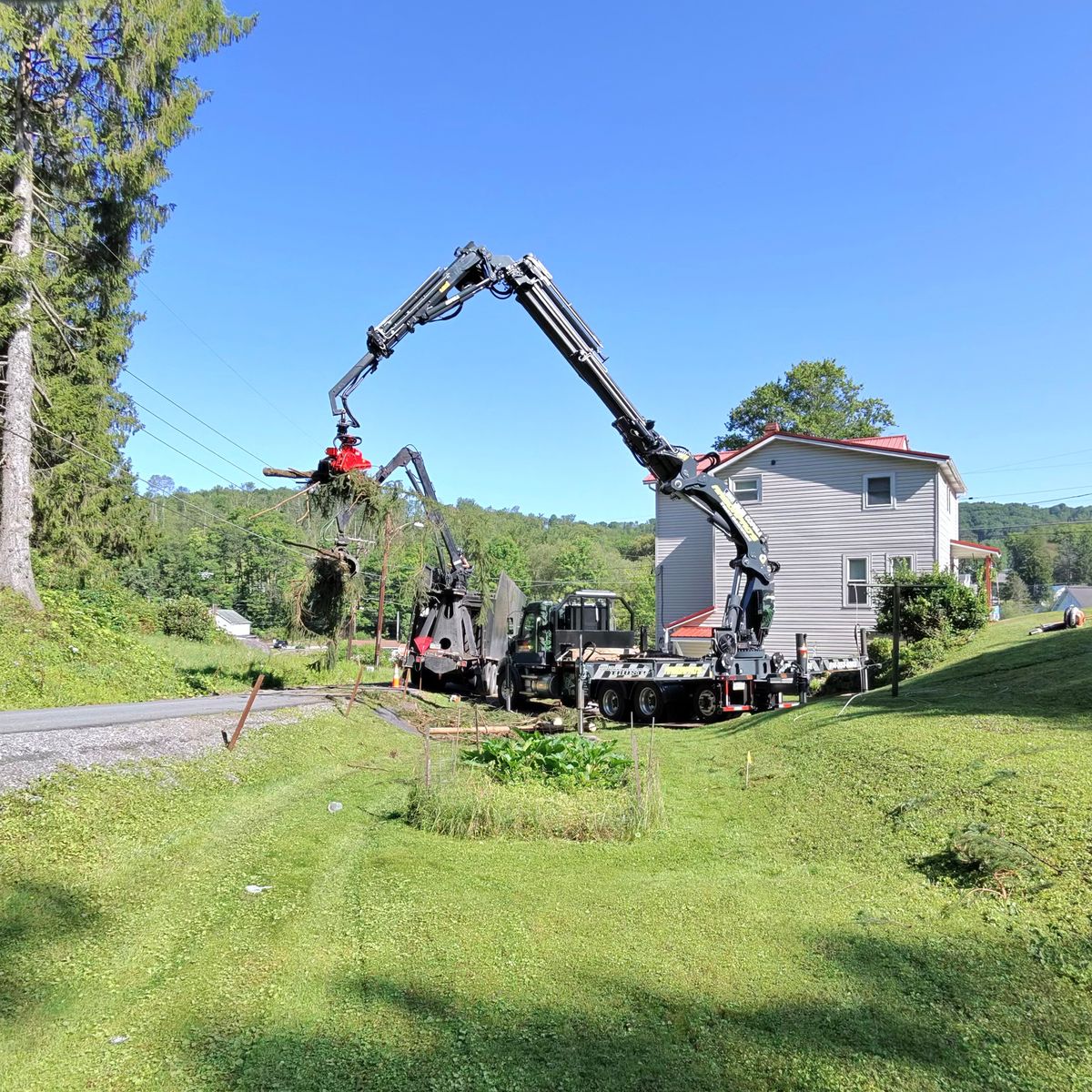
- Knuckle boom cranes with grapple saws for the dead, leaning, or too-large limbs that can’t be dropped conventionally near the road
- Fecon Bull Hog forestry mulcher for brush and undergrowth along the shoulder and right-of-way
- EHAP certification for work in corridors that share space with energized utility lines
Most local crews can do one of those things. We do all of them, which is why daylighting a mile of road takes us days, not weeks.
Credentials and insurance
PA Contractor License PA079160 · Registered state vendor #421406 · EHAP-certified crew · Full general liability and workers’ compensation coverage · Active utility contracts in the Central PA region.
For municipal and commercial RFPs, we can provide a current W-9, insurance certificate, and license documentation on request.
Service area
Road daylighting across Clearfield County, Centre County, Jefferson County, and Elk County — Curwensville, DuBois, State College, Clearfield, Punxsutawney, Brookville, Bellefonte, Philipsburg, Ridgway, St. Marys, and surrounding communities. For township and utility projects, our service area extends further on request.
Related services
Running a township, HOA, or private road? Call for a free corridor walk-through. We’ll tell you what needs cutting, what can wait, and what it costs.
(814) 553-0303 · Free on-site estimate · Available for storm-damage road clearance.